How to improve posture and maintain a healthy back
Good posture not only determines our appearance but also affects the health of the entire body. Correct posture ensures optimal load distribution on the spine, joints and internal organs, while incorrect posture can lead to pain, deformities and chronic diseases.
What is posture and why is it important?
Posture is the position of the body in space, which is formed under the influence of the muscles, skeleton and habits of a person. It is a complex indicator that includes:
- Position of the feet
- Work of the lower leg muscles
- Condition of the knee and hip joints
- Position of the pelvis and spine
- Center of gravity of the body
If the posture is balanced, the body functions optimally. However, incorrect posture leads to the following problems:
- Back, neck, joint pain
- Cyclic disorders (leading to diseases such as varicose veins, hemorrhoids)
- Spinal deformities (scoliosis, hyperlordosis, kyphosis) and, as a result, diseases of other organs (headache, disorders of the cardiovascular and digestive systems and many others)

Almost all people have asymmetry, which is related to the way of life in the modern world. Asymmetry manifests itself as follows: most often a person stands, leaning on the stronger leg, and to compensate, the body shortens the length of the weaker leg. As a result, the wrong muscles are involved, a pelvic tilt occurs, which leads to wear and tear of the joints, both knee and hip. Often because of this, at the age of 45–50, people need surgical joint replacement.
How to determine if your posture is correct?
A straight posture has the following signs:
- The feet are firmly on the floor, parallel to each other, the weight is distributed evenly. The main load of the weight in the foot should be on the toes, not on the heels.
- The knees are slightly bent (not completely straightened, the knee joints are not “drawn” inward).
- The pelvis is not tilted, slightly tense and slightly twisted forward.
- The abdominal muscles are toned, the stomach is tightened.
- The shoulders are straight, not rounded, but not tense either.
- The head is in line with the neck and the center of the shoulders, not stretched forward.
If you stand in front of the mirror and notice asymmetry (one shoulder higher, a protruding belly, crooked legs), this is a sign of a posture violation.
Why do posture problems arise?
The main causes of incorrect posture:
- The habit of shifting body weight onto one leg while standing causes pelvic tilt.
- Weak back and core muscles.
- Incorrect sitting (leg on leg, crossing legs at the ankles, slouching at the table).
Posture problems in children often arise due to:
- Insufficient physical activity.
- The habit of sitting incorrectly.
- Incorrectly selected shoes. The desire of parents to accustom children to soft soles can only harm.
How to improve posture?
1. Working with feet
Proper posture starts with strong feet. When walking, I recommend avoiding starting a step with your heels and pressing on your toes. Every step with an emphasis on the heel is a blow to your spine!
To strengthen your feet, I recommend the following exercises:
- Walking barefoot (on sand, grass, on special mats)
- Exercises to raise the arch (raising your toes alternately, rolling to the inside/outside of the foot, balancing on one leg)
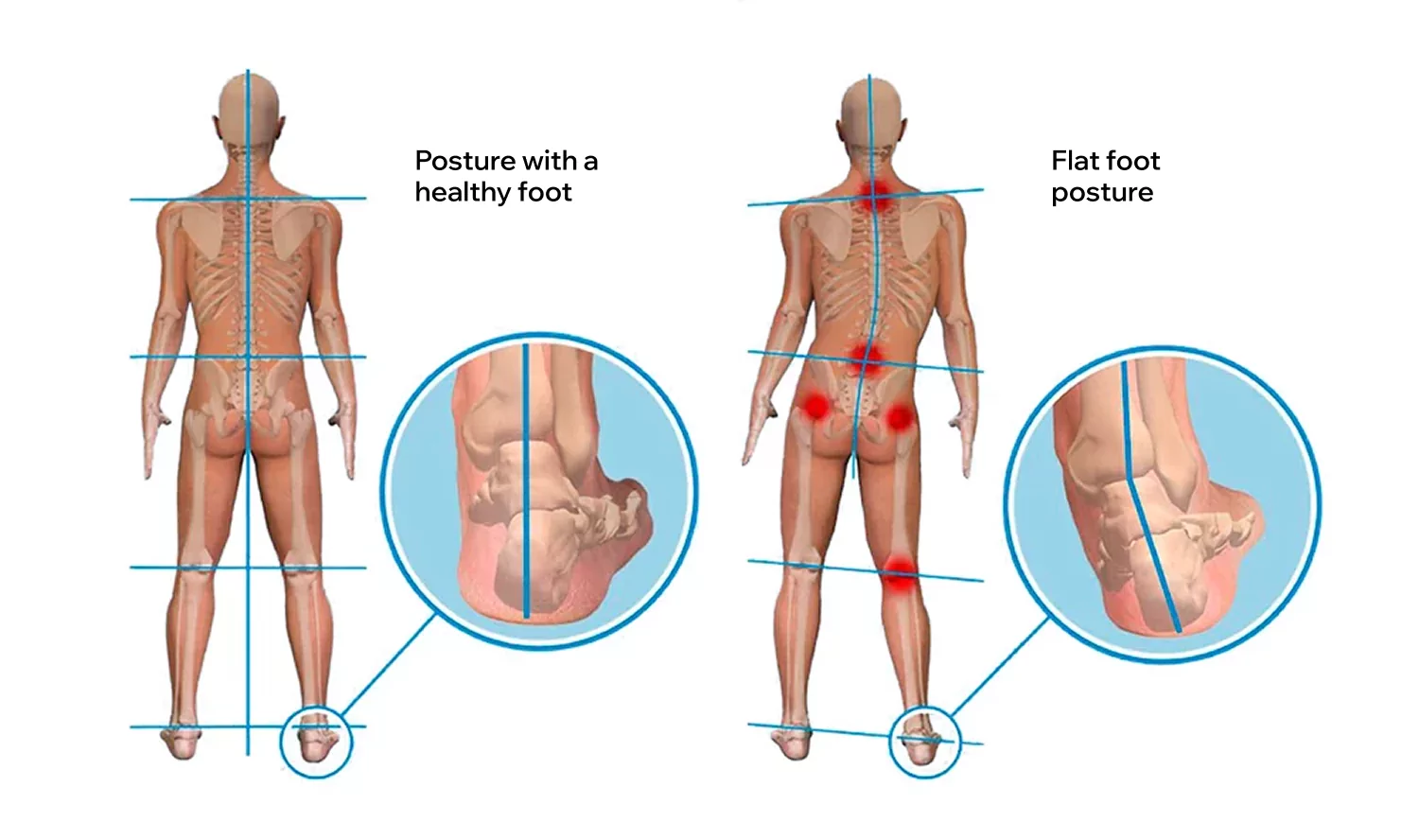
Flat feet are a very common disease in modern society. According to various estimates, between 20% and 37% of the population has some degree of flat feet. An incorrect arch of the foot disrupts the natural cushioning during walking, leading to joint overload (knee, hip), back pain, poor posture, and even the appearance of a double chin. Having flat feet is especially dangerous for children, as flat feet can affect the development of the entire musculoskeletal system, which is still developing.
Important! I categorically do not recommend running to people who are overweight, obese, have body asymmetry, or have flat feet. Instead of running, I suggest exercising on an exercise bike, adjusting your body position so that you have to practically “pull” the pedal with your toes.
2. Body posture correction. We learn to do it correctly:
- stand – weight evenly on both legs, knees slightly bent;
- sit – back straight, feet on the floor;
- walk – make a soft roll of the foot from toe to heel.
3. Perform simple exercises for even posture
- Training with a stick (rotating the stick ensures high-quality work on all muscle groups)
Examples of exercises with a stick can be viewed in the video:
- Standing on one leg (start with 3 minutes on each leg, gradually train to stand longer)
- Squatting with the correct technique (feet parallel, knees do not go beyond the toes)
You cannot correct your posture “locally”. Working on your posture requires a comprehensive approach. For example, a person wants to pump up his abs and thus reduce his bulging belly. But first of all, it is necessary to reduce the body’s fat content through a balanced diet and, at the same time, work on one’s posture. Very often, the stomach bulges forward precisely because of poor posture and excessive curvature of the lower back.
4. Strengthen your core muscles
Strong back, abdominal, and pelvic floor muscles are the foundation of healthy posture. The easiest things you can do yourself:
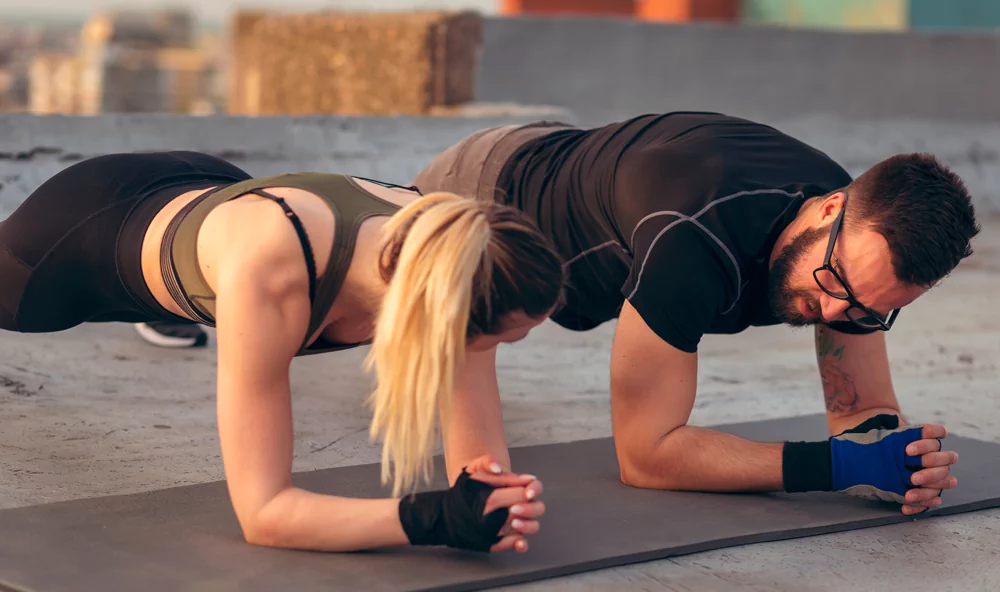
- Plank (start with 1 minute daily)
- Stick training
- Ab curls
How to maintain a healthy back?
- Monitor your body position (especially when working at a computer).
- Avoid sitting for long periods of time (get up every 30 minutes).
- Sleep on a properly selected mattress (not too soft, but not too hard) and a comfortable pillow.
- Wear comfortable shoes that will not squeeze your toes.
- Exercise daily.
Good posture is not only aesthetic but also a guarantee of health. Start working on it today!
A healthy body starts with correct posture!